
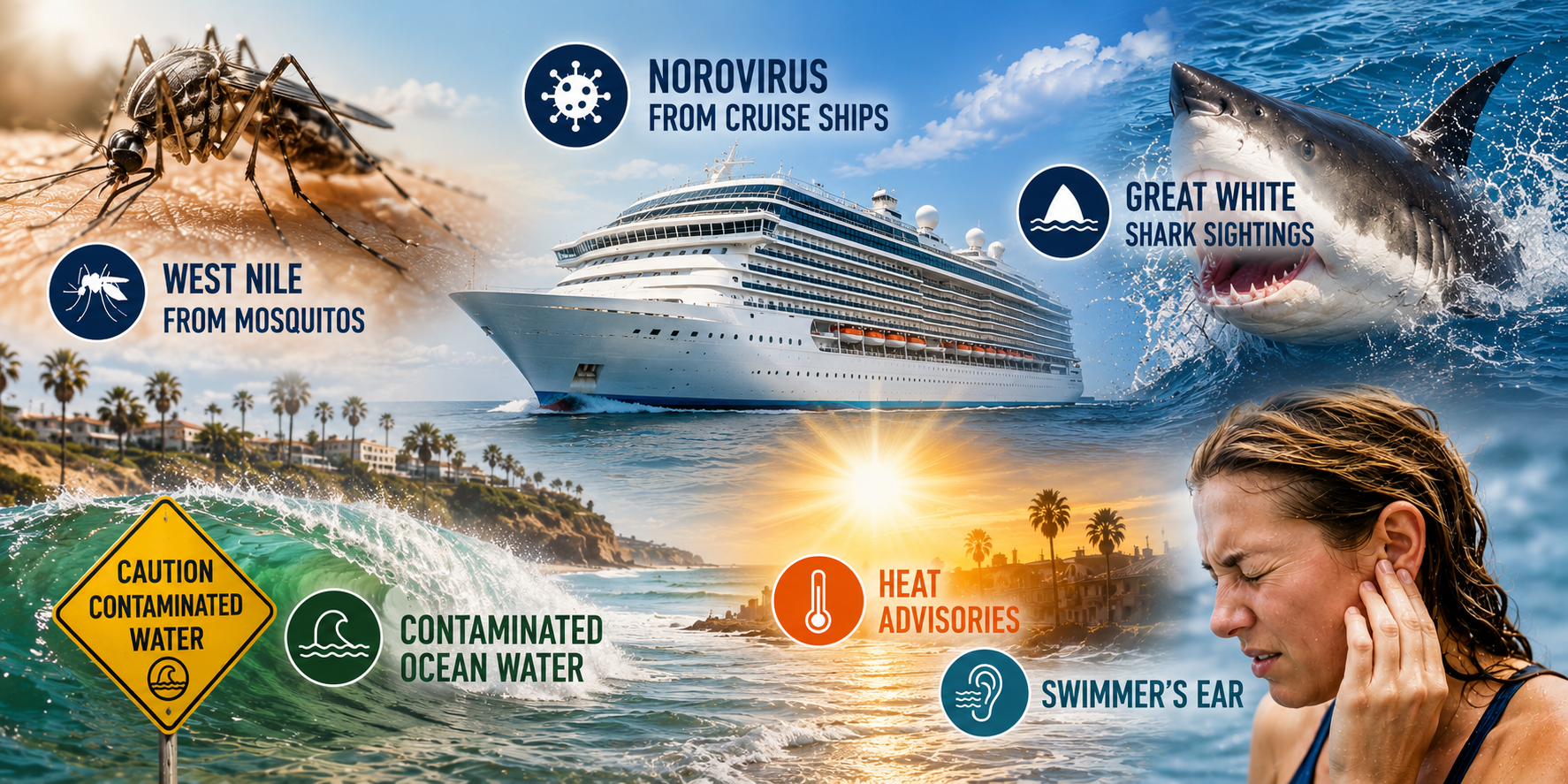
Sunburns, sprained ankles, pool-related mishaps: summer brings a whole new set of ailments through our doors. From June through September, five conditions top the list: 1. Respiratory illness, 2. Ear pain and infection, 3. Injuries from falls and sprains, 4. UTIs, and 5. Sore throat.
Foot/ankle injuries, wound care, pink eye, rashes, and fever round out the top ten. When these summer illnesses and injuries combine with trending issues (like e-bike crashes and heat wave advisories), our community has a lot to stay ahead of in the summer. Whether you’re looking out for your kids home on summer vacation, or just trying to avoid injuries yourself, here’s a list of the top reasons we see patients in the summer and how to prevent them.
Jump to a section:
Swimmer’s Ear Spikes in the Summer: Prevention and Treatment
Ear pain is one of the most common reason patients visit Sand Canyon Urgent Care in the summer. Swimmer’s ear (otitis externa) is very often the cause, specifically in the summer and early fall.
Unlike the middle-ear infections that follow a winter cold, swimmer’s ear is a skin infection of the outer ear canal. It’s triggered when water gets trapped after swimming, creating a moist environment where bacteria thrive. It’s quite common, but that doesn’t make it any less painful.

A landmark CDC study found that swimmer’s ear accounts for roughly 2.4 million healthcare visits nationwide each year. Kids are especially prone to it because their narrower ear canals drain less efficiently than adults. The good news? It’s one of the most preventable conditions on this list.
To avoid swimmer’s ear:
Dry ears thoroughly after swimming by tilting the head to each side and drying with a towel or hair dryer on a cool setting.
This is the single best defense. Over-the-counter drying drops after pool time can help too, and silicone earplugs are worth considering for kids who swim daily.
What you shouldn’t do is reach for a cotton swab: it strips away the earwax that naturally protects the canal and can push debris deeper, raising infection risk.
Early symptoms of swimmer’s ear include:
itching inside the ear, pain when tugging the earlobe, redness, & drainage or a “plugged up” feeling.
If those symptoms show up, don’t wait it out. Untreated swimmers ear can worsen quickly, and prescription antibiotic drops typically bring relief within 48 hours. Here at Sand Canyon Urgent Care, we can diagnose and treat swimmer’s ear same-day, without the wait of a pediatrician appointment. Treatment may include a professional ear lavage or cleaning performed by a doctor. This clears out the infection-causing debris and wax with a powerful stream of water, allowing medicated eardrops to work effectively.
Please note: Flushing the ear at home with a kit is dangerous and can push an infection deeper or damage the eardrum.
Swimmer’s Ear FAQs
Q: What’s the difference between swimmer’s ear and a regular ear infection?
A: Swimmer’s ear (otitis externa) is an infection of the outer ear canal caused by trapped water, while a typical ear infection (otitis media) develops behind the eardrum, usually following a cold. Swimmer’s ear is more common in summer; middle-ear infections are more common in winter.
Q: How can I prevent swimmer’s ear before a pool or beach day?
A: Dry ears thoroughly after swimming by tilting the head to each side, use a towel or hair dryer on a cool setting, consider over-the-counter drying drops, and avoid cotton swabs, which strip protective earwax.
Q: What are the first signs of swimmer’s ear?
A: Itching inside the ear, pain when tugging the earlobe, redness, a “plugged up” feeling, and sometimes drainage. Fever is possible but uncommon.
Q: When should swimmer’s ear be seen by a doctor?
A: As soon as symptoms appear — early treatment with prescription drops typically brings relief within 48 hours, and untreated infections can worsen quickly.
Ocean & Beach Safety Check
Great White Shark Sightings in SoCal
Living 20 minutes from Newport, Laguna, and Crystal Cove means beach days are nothing new for Irvine families. However, the ocean poses some increased risks this year that are worth keeping updated about. Researchers are calling this the “sharkiest summer” in a decade. This past March, lifeguards closed a mile of coastline off West Newport after an 8-foot great white shark was spotted circling a surfer. They cleared people out of the water and monitored the area for hours before reopening it. A second great white sighting off Huntington Beach in April forced a full-day halt to a major surf competition near the pier. Another great-white sighting off the Southern California coast was captured by a drone in mid-July. If you or your family are planning to spend time in the ocean this summer, we recommend swimming in groups, avoiding dawn/dusk hours, and heeding lifeguard closures as soon as they come out.
Contaminated Ocean Water
A far more common (and less dramatic) beach risk is water quality. Around this year’s Fourth of July weekend, a stretch of Laguna Beach coastline at Thalia Beach was shut down for a minimum of three days after a sewage line malfunction. This led to roughly 2,000 gallons releasing into the ocean. Yuck. The closure remained in place until follow-up testing confirmed bacteria levels were safe.

It’s fast and easy to call the county’s Beach Closure Hotline (714-433-6400) or check posted signage. Rain is a big factor too. Runoff can leave coastal waters unsafe for up to 72 hours afterward. On the encouraging side, eight Orange County beaches, including several in Huntington and Sunset Beach, recently made Heal the Bay’s Honor Roll for consistently excellent water quality.
Beach Injuries
As an urgent care, we have a few beach-related honorable mentions. Stingray stings, jellyfish stings, cuts from rocks and shells, and sprained ankles from uneven sand are far more common injuries than shark bites:
- Stingray stings should be treated with hot water immersion as soon as possible.
- Cuts from shells or rocks often look minor but can carry bacteria and need proper cleaning.
- Rolled or twisted ankles that are swollen or won’t bear weight is worth an X-ray to rule out a fracture, which we can perform right here in our Irvine clinic.
Ocean & Beach Safety FAQs
Q: Are shark sightings common at Newport or Huntington Beach?
A: Shark sightings occur periodically along the Orange County coast, occasionally prompting temporary beach closures, but attacks resulting in injury remain rare.
Q: How do I know if a beach is safe to swim at?
A: Check the Orange County Beach Closure Hotline (714-433-6400) or posted lifeguard signage, especially after recent rainfall — runoff can make coastal waters unsafe for up to 72 hours.
Q: What should I do for a stingray sting?
A: Stingray stings happen surprisingly frequently in Orange County, with hundreds occurring during peak summer, particularly when the water is wam. If you get one, rinse the area and immerse the sting in hot (not scalding) water as soon as possible, which helps break down the venom; seek medical care if pain persists or signs of infection develop.
Q: When does a beach cut need stitches?
A: If a cut is deep, won’t stop bleeding after direct pressure, has jagged or gaping edges, or shows signs of infection, it should be evaluated promptly rather than treated at home.
When the Kids Aren’t Alright: Summer Illnesses & Injuries
Water Safety
In early July, an OC toddler was pulled from a backyard pool by an older sibling after being in the water for two to four minutes before rescue. The grandmother’s quick CPR saved the child’s life and resulted in a safe recovery.

However, drowning remains the leading cause of death for kids ages 1-4. Every year in the United States there are an estimated 11 drowning deaths per day. It happens quickly and silently, often without splashing, even when adults are nearby. Kids shouldn’t be in the water without an adult’s uninterrupted supervision.
Locally, Irvine hosted a free water safety event this month at the William Woollett Jr. Aquatics Center, where parents could trade unapproved inflatable armbands for Coast Guard-approved life jackets and get hands-on safety training. Events like these run throughout the county all summer and are worth attending before your next pool day. Sign up for email notifications from the City of Irvine to hear when similar events are happening.
Playground Safety
Beyond the water, playgrounds are a major source of summer injuries. Falls from monkey bars, swings, and climbing equipment are a leading cause of broken arms, wrists, and ankle sprains in kids, and falls from higher platforms can result in head injuries or concussions. Simple habits, like feet-first on slides, both hands on monkey bars, drying off before climbing, cut down on a lot of these visits.
Illness
On the illness side, summer brings its own version of “back to school” viruses: two-to-five-day fevers with congestion, occasional stomach upset, and a steady stream of strep throat and viral rashes, especially once camp and travel bring kids into close contact again.
Heat Exposure
Heat rash (small, itchy red bumps in skin folds) is common in the Irvine sun and is different from allergic or viral rashes. It usually resolves with cooling and loose clothing rather than medication.
Watch for dehydration or heat exhaustion signs – dizziness, minimal urination, unusual fussiness or lethargy – since these can escalate quickly in kids and warrant prompt evaluation.
Kids’ Summer Illnesses & Injuries FAQs
Q: What are the most common playground injuries in summer?
A: Falls from monkey bars, swings, and climbing equipment are the leading cause of broken arms, wrists, and ankle sprains in kids, with head injuries possible from higher platforms.
Q: How can I prevent drowning at home pool gatherings?
A: Maintain constant, distraction-free adult supervision near water, use Coast Guard–approved life jackets rather than inflatable armbands, and always check the water first if a child goes missing.
Q: How do I tell heat rash apart from other summer rashes?
A: Heat rash appears as small, itchy red bumps in skin folds or areas covered by clothing, and typically resolves with cooling and loose clothing rather than medication — unlike allergic or viral rashes.
Q: When does a child’s fever need urgent care versus a pediatrician visit?
A: Fevers accompanied by dehydration, unusual lethargy, difficulty breathing, or a fever in an infant under 3 months should be evaluated promptly, especially outside regular pediatrician hours.
It’s Heating Up: Heat Rash, Heat Exhaustion, Heat Advisories, & Heat-Related Illness
Mid-July has kicked off a major summer heat wave for Southern California. The National Weather Service issued a Heat Advisory with temperatures reaching up to 112 degrees away from the coast. Even coastal communities are seeing temps above the norm. Irvine’s inland location means residents often feel this more than beach cities do, even on days when Newport or Laguna stay comfortably in the 70s.
Heat exhaustion is the most common heat illness we see, and it can sneak up fast. Early warning signs include:
- Heavy sweating,
- weakness,
- dizziness,
- nausea
- a fast but weak pulse.
To prevent heat exhaustion:
- drink water before you’re thirsty,
- take breaks in shade or AC,
- wear light and loose clothing,
- avoid strenuous outdoor activity during peak afternoon heat.

If untreated, heat exhaustion can progress to heat stroke, a true medical emergency.
Heat stroke is marked by a body temperature above 103°F, hot and dry (or unexpectedly damp) skin, confusion, and even loss of consciousness.
If someone you know reaches this point, call 911 rather than driving to urgent care yourself. Kids, older adults, outdoor athletes, and anyone without reliable air conditioning are at highest risk.
If you or your child are feeling “off” after time outside this week – headache, nausea, unusual fatigue – it’s worth being evaluated rather than waiting it out, especially with temperatures this high forecast to continue into the weekend.
Heat-Related Illness FAQs
Q: What’s the difference between a Heat Advisory and an Excessive Heat Warning?
A: A Heat Advisory is issued when high temperatures pose an elevated health risk; an Excessive Heat Warning signals more dangerous conditions where heat-related illness is likely even for healthy individuals.
Q: What are the early signs of heat exhaustion?
A: Heavy sweating, weakness, dizziness, nausea, headache, and a fast but weak pulse are early signs; symptoms typically improve with rest, fluids, and cooling.
Q: How is heat stroke different from heat exhaustion?
A: Heat stroke is a medical emergency marked by a body temperature above 103°F, hot/dry or unexpectedly damp skin, confusion, or loss of consciousness — call 911 rather than seeking urgent care.
Q: Who is most at risk during a heat wave?
A: Young children, older adults, outdoor workers and athletes, and anyone without reliable access to air conditioning face the highest risk of heat-related illness.
Cruise Travel & Mosquito-Related Illness in California
Two very different summer travel risks are making local headlines right now, and both are sending people straight to urgent care. The first is mosquitoes, and they’re close to home.
As of early July, Orange County’s Mosquito and Vector Control District had confirmed West Nile virus in mosquito samples from 13 cities across the county, with positive samples more than doubling in a single week.

Fullerton has reported the largest share of cases at 39, prompting officials to schedule truck-mounted mosquito spraying in a several-square-mile area. Buena Park and Anaheim have also seen a significant number of mosquito samples positive for West Nile. This is an active, local health advisory, and a timely reminder to use EPA-registered repellent and dump standing water around the house before your next backyard barbecue or trip.
The second risk shows up after a very different kind of summer plan: a cruise. Norovirus remains the leading cause of illness outbreaks on cruise ships, and 2026 has been a busy year for it. In early July, a Princess Cruises ship returning to San Francisco sickened 125 passengers and crew, the cruise line’s third norovirus outbreak of the year. Nationally, seven cruise ship illness outbreaks have been reported to the CDC so far in 2026. The virus spreads easily in close quarters through contaminated surfaces and person-to-person contact. The symptoms – vomiting and diarrhea – typically show up within a day or two of exposure, sometimes before travels even make it off the ship.
Between mosquito-borne illness locally and GI illness after travel, “just got back and don’t feel right” is a very common reason our patients come in throughout July and August.
Cruise Travel & Mosquito-Related Illness FAQs
Q: Why is West Nile virus a concern in Orange County right now?
A: Mosquito samples testing positive for West Nile virus have been confirmed across multiple Orange County cities this season, with health officials conducting targeted mosquito control in response.
Q: What are the symptoms of a mosquito-borne illness?
A: Most infected people have no symptoms; those who do may experience fever, headache, body aches, vomiting, diarrhea, or a rash within 2–6 days of a bite.
Q: Why do cruises increase the risk of getting sick?
A: Close living quarters, shared dining areas, and high passenger turnover make it easier for illnesses like norovirus to spread person-to-person and via surfaces.
Q: What should I do if I feel sick after returning from a cruise or trip?
A: Stay hydrated, monitor symptoms, and seek care if you experience persistent vomiting, diarrhea, high fever, or signs of dehydration, since these may require evaluation beyond home care.
What Our Own Data Tells Us About Summer Injuries in Irvine
We didn’t have to guess what topics to cover in this guide. We pulled it straight from our own visit data. Looking at our patient visits from June through September across 2025 and 2026, five conditions topped the list:

Foot and ankle injuries, wound care, pink eye, rashes, and fever round out the top ten. The real story is how preventable most of these ailments are:
- Ear infections drop sharply when ear plugs are used and ear canals are free from wax.
- Sprains and fractures often trace back to running on wet surfaces, uneven sand, wet playground equipment, or skipping a warm-up before sports.
- Fevers and sore throats climb every time camps, travel, and group activities bring kids into closer contact.
A few small habits go a long way. Summer doesn’t have to slow your family down. It just means you need to know what to watch for, and that Sand Canyon Urgent Care is here, walk-in and no appointment needed, when a medical concern does come up. Our physicians are ready to help, for whatever this season throws your way.


